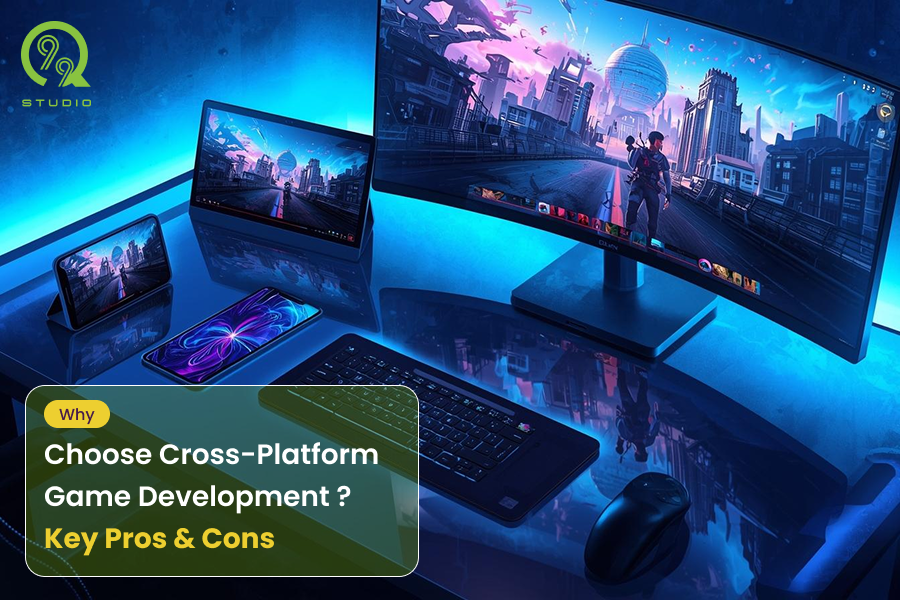
In today’s fast-growing gaming industry, reaching players across multiple devices is more important than ever. Whether you're developing a casual mobile game, a multiplayer title, or an educational simulation, choosing the right development approach can make or break your success.
One of the most effective strategies for maximizing reach and efficiency is cross-platform game development. This method allows developers to build games that run on multiple platforms—such as Android, iOS, PC, and consoles—using a single codebase.
In this blog, we’ll explore what makes cross-platform development so valuable, its major advantages, potential drawbacks, and why hiring skilled game developers can help you navigate this development model effectively.
What Is Cross-Platform Game Development?
Cross-platform game development refers to the process of creating a game that can be deployed across multiple platforms without rewriting the entire code for each device. Engines like Unity, Unreal Engine, and frameworks such as Flutter or React Native (for 2D/casual games) support cross-platform workflows.
This approach allows game studios, startups, and educational institutions to save time, reduce development costs, and expand their player base significantly.
Key Advantages of Cross-Platform Game Development
Below are the major benefits that make cross-platform development an attractive choice for modern game creators.
- Broader Audience Reach
Launching a game on multiple platforms instantly expands your potential player base. Instead of limiting your game to one ecosystem (like Android or PC), you can access users on:
- Android
- iOS
- Windows
- macOS
- Web browsers
- Consoles
- VR/AR headsets
This is especially beneficial for businesses or schools looking to reach students on different devices or for companies aiming for higher engagement.
- Cost-Effective Development
Cross-platform tools allow developers to write one codebase and deploy it everywhere. This significantly reduces:
- Development time
- Total production budget
- Resource requirements
- Maintenance costs
For example, a Game Development Company can deliver both Android and iOS versions without doubling the workload, helping startups and educational institutions stay within budget.
- Faster Time-to-Market
Since the majority of the code is shared across platforms, developers can build and launch games much faster. This is ideal for:
- Rapid prototyping
- MVP (Minimum Viable Product) launches
- Seasonal or event-based game releases
- Educational games with tight academic schedules
Teams can test gameplay, collect user feedback, and release updates more quickly.
- Unified Updates and Maintenance
In native development, updates must be applied separately for each platform. In contrast, cross-platform game development enables:
- Single patch updates
- Faster bug fixes
- Shared content additions
- Consistent user experience across all devices
This streamlined workflow saves time and enhances user satisfaction.
- Consistent Gameplay Experience
Cross-platform frameworks aim to deliver a uniform look and feel across all devices. Players get the same:
- Visual quality
- Game mechanics
- Performance standards
- User interface
This consistency strengthens the game’s brand and improves player retention.
Key Drawbacks of Cross-Platform Game Development
While cross-platform development is incredibly beneficial, it also comes with a few challenges.
- Performance Limitations
Cross-platform games may not achieve the same level of optimization as native titles. Issues may include:
- Slightly lower performance
- Delayed access to platform-specific features
- Occasional compatibility challenges
High-end, hardware-intensive games (like advanced 3D shooters or AAA titles) often require platform-specific optimization that cross-platform tools can't match.
- Reduced Access to Native Features
Some unique device features may not be fully supported on cross-platform frameworks, such as:
- Advanced graphical effects
- Certain sensors
- Platform-exclusive APIs
This can limit creative freedom for developers aiming for specialized game mechanics.
- Platform Dependency Issues
Using a single framework means relying heavily on its updates, plugins, and compatibility. If the engine has a limitation, your game may inherit it.
- Larger App Size
Cross-platform games sometimes have larger installation sizes due to additional libraries required for different platforms. This may affect:
- Player download willingness
- App store performance
- Storage availability, especially on older devices
Cross-Platform vs Native Development: A Quick Comparison
| Feature | Cross-Platform | Native Development |
| Codebase | One codebase | Separate codebases |
| Cost | More affordable | Expensive |
| Development Speed | Faster | Slower |
| Performance | Good | Best |
| Platform Features | Limited access | Full access |
| Maintenance | Easier | More complex |
| Best For | 2D/3D casual, mobile, educational, indie games | AAA games, platform-specific features |
Which Projects Benefit Most from Cross-Platform Development?
Cross-platform development is a great choice if:
- You want to reach a wide audience
- You have a limited budget or small team
- Your game is 2D, mobile, educational, or mid-level 3D
- You need fast development and updates
- You want your game available on both Android and iOS
Native development may be better if:
- You are building a AAA game
- You need max graphic performance
- You require deep platform-specific customizations
The Role of Professional Developers in Cross-Platform Projects
Hiring skilled cross-platform game developers ensures the project is optimized for all devices. A Cross-Platform Game Development Company can help you with:
✔ Performance optimization for multiple platforms
✔ UI/UX design that adapts to different screen sizes
✔ Smooth functionality across operating systems
✔ Code architecture that scales
✔ Faster deployment and testing processes
Whether you're using Unity, Unreal Engine, or other tools, experienced developers can deliver polished, high-quality results.
Conclusion
Cross-platform game development offers a powerful combination of affordability, efficiency, and reach. While it may come with some limitations, the advantages often outweigh the drawbacks for most game types—especially mobile, educational, and indie titles.
- Choose cross-platform: if you want faster development, budget-friendly production, and a wider audience.
- Choose native: if your game requires maximum performance or advanced platform-specific features.
By partnering with a Game Development Company and hiring expert cross-platform game developers, you can ensure your game performs smoothly across all devices and delivers an engaging experience for every player.

 B - 433-442, Money Plant High Street, Near Ganesh Glory, Jagatpur Road, S.G. Highway, Ahmedabad - 382470.
 11006 Kirker Ln, Richmond, TX 77407, USA


