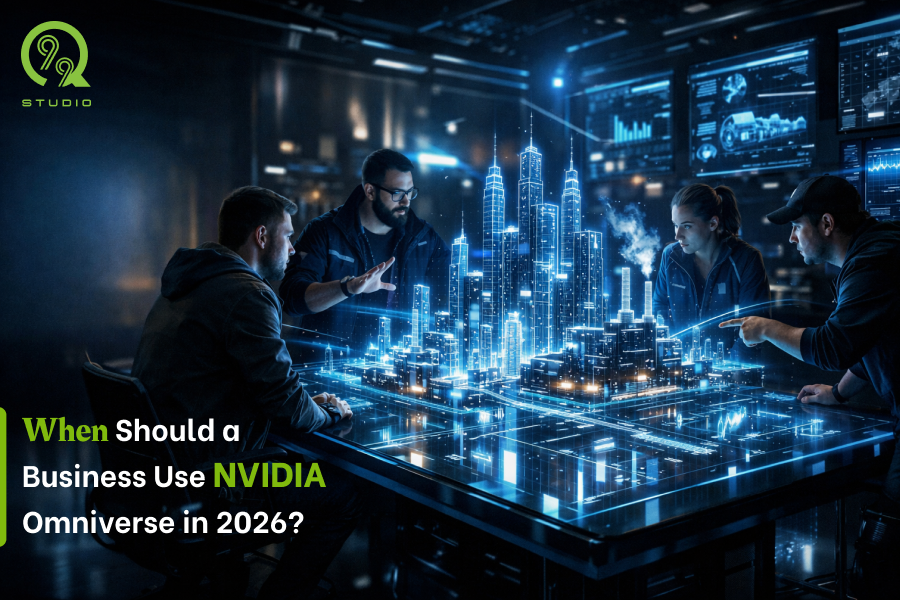
A business should use NVIDIA Omniverse when it needs real-time 3D collaboration, digital twin simulation, AI-powered virtual environments, or large-scale industrial visualization.
NVIDIA Omniverse is an advanced real-time simulation and collaboration platform designed for enterprises working with complex 3D workflows, robotics systems, smart factories, immersive AR/VR experiences, and AI training environments. In 2026, it is no longer just a 3D tool; it is becoming infrastructure for digital transformation.
If your organization is building simulation-first solutions rather than simple interactive applications, Omniverse may be the right investment.
What Is the NVIDIA Omniverse?
NVIDIA Omniverse is a real-time 3D development and simulation platform built on the Universal Scene Description (USD) standard. It connects multiple 3D tools, enables physically accurate rendering, and supports AI-based simulation in a shared collaborative environment.
Unlike traditional game engines, Omniverse focuses on:
- Digital twin development
- Robotics simulation
- Industrial automation testing
- AI model training environments
- Enterprise-scale 3D collaboration
It combines RTX rendering, real-time physics, and AI computing to accurately simulate real-world systems.
When Should a Business Consider NVIDIA Omniverse?
Here are the key business scenarios where Omniverse delivers measurable value:
1. When Building Digital Twins
If your business operates factories, warehouses, smart cities, or industrial systems, Omniverse enables you to create a digital twin, a virtual replica of real-world assets.
Use cases include:
- Factory layout simulation
- Workflow optimization
- Predictive maintenance testing
- Logistics planning
- Infrastructure modeling
Instead of testing changes in the physical world, companies simulate them virtually, reducing cost and operational risk.
Best for: Manufacturing, logistics, construction, automotive, and smart infrastructure.
2. When Developing Robotics or Autonomous Systems
Businesses working on robotics, automation, or AI-powered machines benefit significantly from Omniverse.
Why?
Because it allows:
- Physics-accurate robotic simulation
- Synthetic data generation for AI training
- Safe virtual testing before real deployment
- Reinforcement learning environments
Training AI in real-world conditions is expensive and risky. Omniverse provides a controlled virtual environment that accelerates development.
Best for: Robotics startups, warehouse automation, and AI research teams.
3. When Your 3D Teams Need Real-Time Collaboration
If your designers, engineers, and developers use multiple tools like CAD software, Maya, Blender, or Unreal, Omniverse connects them through a shared USD-based ecosystem.
Instead of exporting and re-importing files, teams can:
- Collaborate live
- See real-time updates
- Avoid version conflicts
- Reduce pipeline delays
This is especially useful for global teams working on complex 3D projects.
4. When Creating Advanced AR/VR and Immersive Simulations
For businesses building enterprise VR training, immersive simulations, or high-fidelity 3D environments, Omniverse provides:
- Physically accurate lighting and materials
- Real-time ray tracing
- Scalable cloud workflows
- AI-enhanced rendering
If your AR/VR projects require industrial-grade realism rather than entertainment-focused interaction, Omniverse becomes highly valuable.
5. When Managing Large-Scale 3D Data
Businesses handling massive datasets, infrastructure models, or smart city simulations often struggle with data complexity.
Omniverse solves this through:
- USD-based asset management
- Interoperability across tools
- Centralized collaboration
- Cloud-based scalability
This makes it ideal for enterprise-level 3D ecosystems.
When Should a Business NOT Use NVIDIA Omniverse?
Omniverse may not be necessary if:
- You are building a simple mobile game
- You do not require simulation accuracy
- Your 3D projects are small in scale
- Budget constraints limit enterprise infrastructure
For standard game development, engines like Unity or Unreal may be more cost-effective.
Omniverse is best suited for simulation-driven and AI-integrated environments.
NVIDIA Omniverse vs Traditional Game Engines
Many businesses ask whether Omniverse replaces traditional engines.
The difference is strategic:
- Game engines focus on interactive entertainment.
- Omniverse focuses on simulation, digital twins, robotics, and AI-driven environments.
If your primary goal is industrial simulation or AI training rather than gameplay, Omniverse is the stronger platform.
Key Benefits of Using NVIDIA Omniverse for Business
✔ Faster Innovation Cycles
Simulate before building physically.
✔ Reduced Operational Risk
Test complex systems safely in virtual environments.
✔ AI Integration
Train machine learning models with synthetic data.
✔ Improved Cross-Team Collaboration
Eliminate fragmented workflows.
✔ Long-Term Scalability
Build enterprise-grade 3D infrastructure.
Why NVIDIA Omniverse Matters in 2026
In 2026, businesses are shifting toward:
- Smart factories
- Autonomous systems
- AI-driven automation
- Immersive enterprise training
- Metaverse-based collaboration
NVIDIA Omniverse sits at the intersection of AI, simulation, and real-time 3D infrastructure. For companies investing in digital transformation, it provides a foundation for scalable innovation.
Final Decision Framework
Your business should consider NVIDIA Omniverse if:
- You require a digital twin simulation
- You are developing robotics or AI systems
- You manage large industrial environments
- You need real-time collaborative 3D workflows
- You aim to reduce physical prototyping costs
If your roadmap includes AI-driven simulation and industrial-scale visualization, Omniverse is not just a tool; it is a strategic infrastructure.
Need Expert Guidance on Omniverse Implementation?
Adopting NVIDIA Omniverse is not just about installing new software; it requires the right simulation architecture, USD pipeline strategy, AI integration planning, and scalable infrastructure design.
If your business is exploring digital twins, robotics simulation, immersive AR/VR environments, or AI-driven 3D workflows, partnering with an experienced development team can significantly reduce risk and accelerate results. At Q99 Studio, we help businesses design and implement advanced 3D, AR/VR, and AI-powered simulation solutions tailored to enterprise needs. Whether you are evaluating NVIDIA Omniverse for digital transformation or building large-scale immersive systems, our team can guide you from strategy to deployment.
 B - 433-442, Money Plant High Street, Near Ganesh Glory, Jagatpur Road, S.G. Highway, Ahmedabad - 382470.
 11006 Kirker Ln, Richmond, TX 77407, USA


