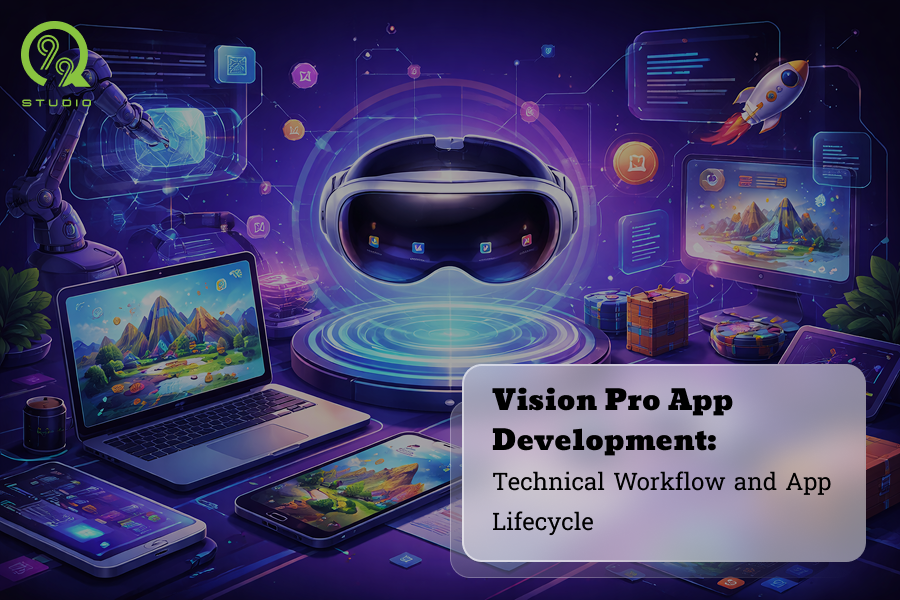
Apple Vision Pro has redefined how applications are designed, built, and experienced. Unlike traditional mobile or desktop software, Vision Pro app development operates within a spatial environment where performance, realism, and user comfort must coexist seamlessly. This makes Apple Vision Pro app development as much an engineering challenge as it is a design opportunity.
For businesses and startups, understanding the technical workflow and lifecycle behind visionOS app development is critical. A poorly structured approach can lead to performance issues, App Store rejections, or uncomfortable spatial experiences. This is why many organizations choose to work with a specialized Vision Pro app development company that understands Apple’s spatial computing ecosystem end to end.
Understanding the Vision Pro App Lifecycle
The lifecycle of Vision Pro app development is continuous rather than linear. From concept validation to long-term optimization, apps evolve alongside Apple’s hardware and visionOS updates.
A complete lifecycle includes planning, architecture design, spatial computing app development, testing, deployment, and continuous improvement. Businesses that treat Vision Pro apps as long-term digital products not experiments gain a measurable competitive edge.
Technical Foundations of Apple Vision Pro App Development
At its core, Apple Vision Pro app development is built on spatial-first architecture. Applications must process real-time input from eye tracking, hand gestures, and voice commands while maintaining visual stability and system efficiency.
The Vision Pro SDK enables developers to manage spatial scenes, application states, and rendering pipelines. Because these requirements differ significantly from mobile development, many businesses choose to hire Vision Pro app developers with direct experience in spatial computing app development rather than adapting traditional iOS teams.
Tools and Frameworks for visionOS App Development
Professional visionOS app development relies on Apple’s native toolchain, extended specifically for spatial computing.
Xcode remains the primary IDE, while Swift and SwiftUI are used to build application logic and spatial interfaces. RealityKit powers 3D rendering and animations, ARKit provides spatial tracking and environmental understanding, and Metal ensures high-performance graphics processing.
Together, these technologies form the technical backbone used by any serious Vision Pro app development company offering production-grade solutions.
Vision Pro App Development Workflow
1. Concept Validation and Technical Strategy
Every successful Vision Pro app development project begins by identifying how spatial computing enhances the business objective. Teams determine whether the application should be windowed, volumetric, or fully immersive based on user intent and operational goals.
This stage defines scope, feasibility, and long-term scalability, ensuring development efforts are aligned with ROI expectations.
2. Architecture Planning and System Design
Architecture planning ensures the application can scale without performance degradation. In visionOS app development, this includes modular code design, efficient asset management, and seamless backend integration.
A well-planned architecture reduces future rework and is a hallmark of an experienced Vision Pro app development company.
3. Spatial UI/UX Engineering
Spatial UI/UX is where spatial computing app development differs most from traditional platforms. Interfaces must exist naturally in 3D space while remaining intuitive and comfortable.
Developers use SwiftUI to create depth-aware layouts that respond smoothly to eye and hand movements. Thoughtful spatial UX design directly impacts user engagement and adoption.
4. Core Development and Integration
During core development, teams implement spatial rendering using RealityKit, manage real-time inputs, and integrate business logic or enterprise systems.
Performance optimization is ongoing throughout this phase. Businesses that hire Vision Pro app developers with platform-specific expertise benefit from faster iteration and fewer technical bottlenecks.
5. Testing and Performance Optimization
Testing in Apple Vision Pro app development goes beyond functional checks. Developers validate frame rate stability, spatial accuracy, memory usage, and power efficiency.
Real-world testing ensures the app behaves consistently across different environments, a critical requirement for approval and long-term usability.
6. Deployment and Distribution
Once optimized, applications are prepared for App Store submission or enterprise distribution. Compliance with Apple’s guidelines is mandatory for all Vision Pro app development projects.
Proper deployment planning ensures smooth rollout and minimizes approval delays.
7. Post-Launch Maintenance and App Lifecycle Management
After launch, the app enters the longest phase of its lifecycle. Updates are required to maintain compatibility with new visionOS releases and hardware improvements.
Ongoing optimization, analytics monitoring, and feature expansion are core components of professional Vision Pro development services.
Business Value of Structured Vision Pro Development
A structured workflow in Vision Pro app development reduces technical risk, improves time-to-market, and ensures long-term scalability.
Businesses gain higher engagement, better retention, and stronger ROI from their investment in Apple Vision Pro app development.
Best Practices for Scalable Vision Pro Apps
Sustainable visionOS app development prioritizes performance, spatial comfort, and modular architecture. Teams should follow Apple’s Human Interface Guidelines, optimize continuously, and plan updates around the Vision Pro roadmap.
These practices are standard among leading Vision Pro app development companies.
Conclusion & Call to Action
Vision Pro app development is not a one-time build it is a long-term technical and strategic investment. A clearly defined workflow and app lifecycle are essential for delivering scalable, high-performance spatial experiences.
As adoption of Apple Vision Pro accelerates, businesses that partner with the right Vision Pro app development company will lead the next wave of digital innovation. Whether you’re planning to hire Vision Pro app developers or explore new spatial products, expertise and execution matter.
Q99 Studio delivers end-to-end Vision Pro development services, combining deep technical knowledge, spatial UX expertise, and lifecycle-driven execution. If you’re ready to build for the future of spatial computing, this is the right moment to begin.


 B - 433-442, Money Plant High Street, Near Ganesh Glory, Jagatpur Road, S.G. Highway, Ahmedabad - 382470.
 11006 Kirker Ln, Richmond, TX 77407, USA


