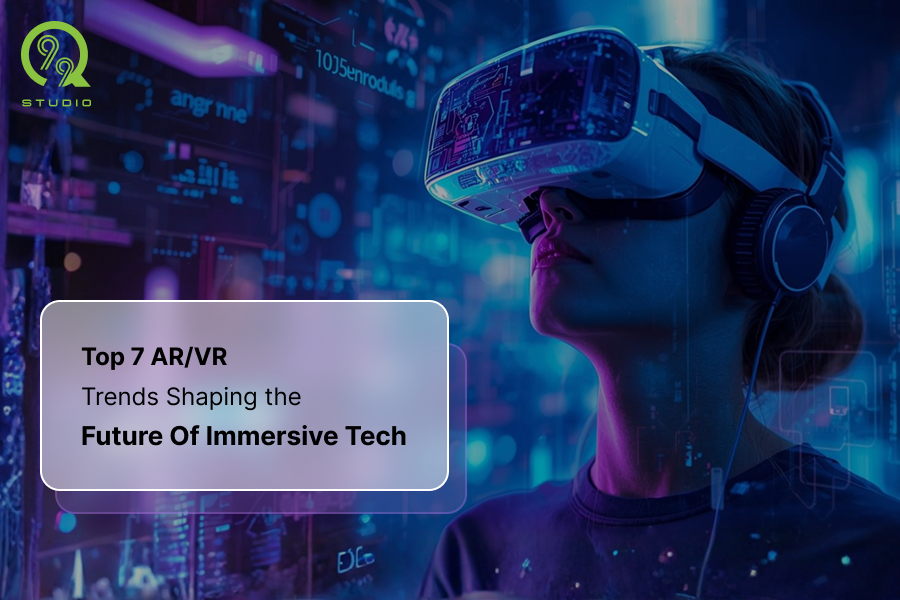
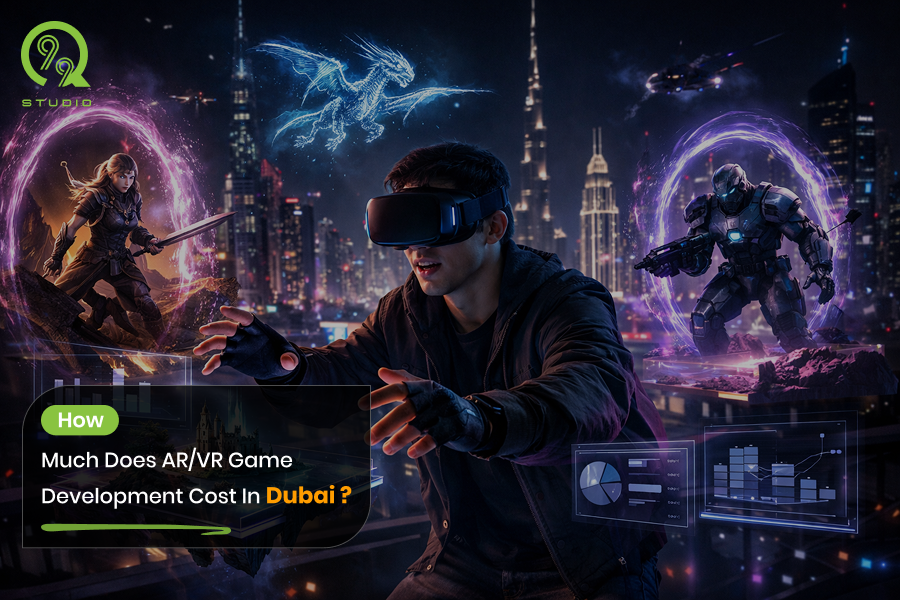
The transformation of Augmented Reality (AR) and Virtual Reality (VR) technologies is astonishingly fast. It is not merely an amusement factor, but a major support for business innovation and customer engagement.
In this post, we will examine the seven trends that will mostly contribute to the future of immersive technology. We will also give necessary insights for the companies that are willing to take the lead in this unexplored area.
1. The AI-Powered Immersive World
AI in AR/VR is not simply an improvement; it is the experience's main component. In AR, AI-powered systems allow for instant object recognition and interaction, making it possible for the user's mobile device.
In VR, AI-driven characters are responding and acting out almost like humans and are therefore forming quite complex and even unpredictable stories. Controlling AI integration is no longer a talent but a must-have skill that has drastically changed the whole AR/VR app development lifecycle.
2. The Rise of the Metaverse and Persistent Worlds
The idea of a metaverse, a universe of connected, always-on, 3D virtual spaces, has finally come out of the realm of science fiction and is slowly being recognized as a formidable business platform. It is not just a new chapter for the gaming industry; it is a whole new world for the trade, partnerships, and socializing.
This transition paves the way for a new AR/VR app development strategy concentrating on scalability, the ability to use different platforms, and the building of money-making ventures in these virtual worlds.
3. Hyper-Realistic Haptic Feedback
True immersion is a sensory experience that engages all the senses. The future of hardware is moving away from visual and auditory information, like the more sophisticated haptic feedback. Such as feeling the texture of a virtual fabric, the recoil of a tool, or the soft touch of a virtual object.
The use of advanced haptic suits, gloves, and controllers is making this a reality, enhancing the sense of presence and creating new possibilities for training, design, and especially AR/VR gaming trends.
4. Mainstream AR: From Phones to Smart Glasses
Easily the main feature on smart devices, mobile AR is one of the biggest drivers for the acceptance of augmented experiences among billions. The next milestone is the more extensive use of the augmented reality smart glasses developed for this purpose.
For businesses, the implications are that the number of people who would utilize AR experiences is going to be significantly increased, and therefore, the need to develop apps for AR/VR is even more acute.
5. Social and Collaborative VR Experiences
The VR world is changing its personality from a single-player game to a social party. The evolution towards this point is highly social. New platforms are being developed where people no longer have to go to different locations to connect.
Social VR is coming up with innovative ways to bond through activities as partying in a virtual concert with people very far away, or even engaging in a flythrough with the design team made up of the best talents from diverse countries.
6. Location-Based and Enterprise VR
On the one hand, home VR gets bigger and bigger, and on the other hand, purpose-built location-based VR experiences are becoming very popular in the same way. These installations are the high-end and multi-sensory ones that provide such an experience that consumer hardware can't do that, and thus the entertainment industry in arcade and theme parks is pronounced.
At the same time, Enterprise VR is widely adopted for training, simulation, and design visualization purposes. This strong commercial application is the reason why the sector will get substantial investments and innovations.
7. The Blurring Line: Mixed Reality (MR) as the Destination
The path of future development isn't a matter of picking one between AR and VR, but rather, it's about the merging of two technologies into one seamless Mixed Reality (MR). With MR viewers, the interaction between the virtual and the real worlds is so convincing that the two become virtually indistinguishable.
For example, a user might perceive a digital animal to be running on their real couch, or they might be able to perform operations on a digital engine using a real tool.
Conclusion: Your Gateway to the Immersive Future
These trends draw a picture of a technological landscape that is not only dynamic but also very impactful. The present is the time to position the company in case of a corporate acquisition of AI in AR/VR for creating smarter applications. A decision made strategically to either hire AR developer or a VR developer from a partner company like Q99 Studio that is well-trained in the field brings in not only the skill but also the vision that is needed to transform these trends into concrete and successful projects. Following the trends is not the only thing we do; we also help our customers create their own.

 B - 433-442, Money Plant High Street, Near Ganesh Glory, Jagatpur Road, S.G. Highway, Ahmedabad - 382470.
 11006 Kirker Ln, Richmond, TX 77407, USA


