If you have a killer idea for a mobile game, the first question that pops into your head is: How long is this going to take?
It's the ultimate how long is a piece of string? question. In 2026, the landscape of game development is faster thanks to AI-assisted workflows and more powerful engines, but player expectations for polish are higher than ever. To give you a direct answer: In 2026, simple mobile games take 3–6 months; complex ones take 12–24+ months.
For indie developers and startups, time is literally money. Whether you are navigating a solo indie dev timeline or planning a high-fidelity 3D project with a full studio, understanding the phases of production is the only way to stay on budget. This guide breaks down the realistic mobile game development timeline to help you move from a concept to a successful store listing.
Mobile Game Development Timeline in 2026 by Complexity
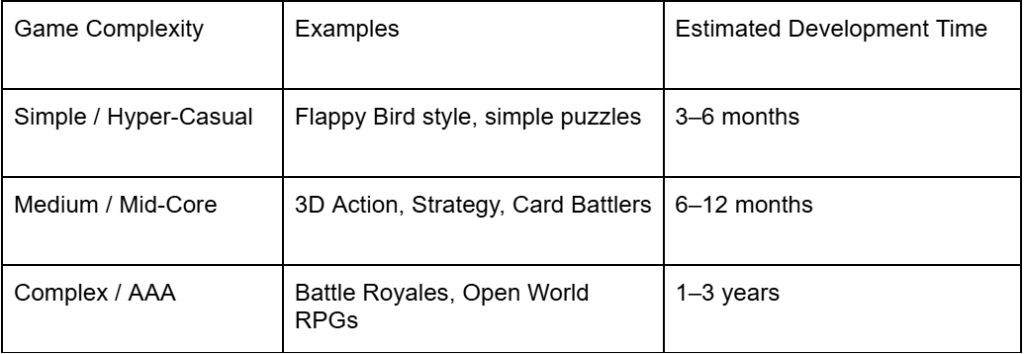
The scope of your game is the primary driver of your schedule. A simple puzzle game doesn't just need less code; it requires fewer custom assets, less balancing, and a lighter backend infrastructure.
2026 Build Estimates
The Standard Production Phases
Regardless of the scale, most successful projects follow this specific rhythm:
- Ideation & Market Research (2-4 weeks): Defining the Core Loop and ensuring there is a target audience for the concept.
- Prototype / Vertical Slice (1-2 months): Building a grey box version to prove the gameplay is actually fun before investing in art.
- Full Development (3-12+ months): The heavy lifting—creating 3D models, coding systems, and integrating the UI.
- Testing & Polish (1-3 months): Bug fixing, performance optimization, and A/B testing for user retention.
- Launch & Soft Launch (Ongoing): Releasing in limited regions to gather data before a full global rollout.
How Long Does It Take to Make a Mobile Game in 2026?
When asking how long it will take to make a mobile game in 2026, you have to account for the rise of procedural tools.
Simple Games
Simple games usually focus on one core mechanic. By utilizing modern frameworks, a small team can build a polished MVP in just a few months. How long it takes to make an indie mobile game of this size often depends on the asset flip vs. custom ratio. If you use high-quality modular asset kits, you can cut the mobile game development time by nearly 30% compared to traditional methods.
Complex Games
Complex games like modern Battle Royales or character-driven RPGs involve massive networking requirements. In 2026, players expect cross-play and cloud-save features as a baseline. Building the architecture to support thousands of concurrent players while maintaining high-end visuals adds significant time to the backend development and QA phases.
Unity vs Unreal: Time to Build Mobile Games in 2026
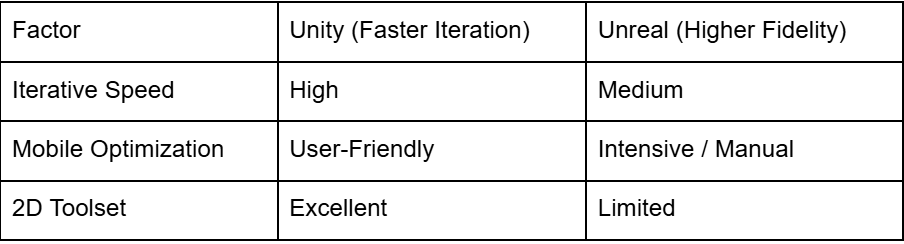
Your choice of engine is a strategic decision that dictates how long it takes to develop mobile game estimates.
Unreal Engine: The powerhouse for high-fidelity 3D. While Unreal 5.x offers breathtaking visuals, the optimization process for mid-range mobile devices can be more labor-intensive, potentially lengthening the final polish phase of your timeline.
Unity: Remains the industry standard for mobile flexibility. It is generally 20-30% faster for 2D and casual 3D games. Because the ecosystem is so vast, building a mobile game with Unity is usually faster for teams aiming for rapid deployment and broad device compatibility.
Factors Affecting Mobile Game Development Time
Even the best-laid plans can face delays. Here are the common culprits:
- Team Size: A solo developer might take 18 months to build what a team of five can finish in 5 months.
- Custom vs. Store Assets: In 2026, custom-sculpted 3D characters are the biggest time sink. Using stylized or modular assets can save months of work.
- Scope Creep: The urge to add just one more feature, like a social hub or a daily quest system, late in the cycle is the leading cause of project failure.
- Engine Experience: The how long to develop a mobile game clock starts only when the team is fluent in the tools. Learning on the job can double your timeline.
Tips to Speed Up Your Mobile Game Dev Timeline
To get your game into the hands of players faster, consider these actionable steps:
- Focus on the MVP: Launch with the fun part first. You can always add more levels and skins in a Version 1.1 update.
- Reusable Architecture: Build systems like inventory or leaderboards that can be reused in your next project to save time in the long run.
- Outsource Art & Sound: Unless you are a specialist, your time is better spent on gameplay logic. Outsource the visuals to keep the production line moving.
- Automated Testing: Use 2026-standard automated QA tools to find crashes early, rather than waiting for a manual tester to find them 10 months into development.
Conclusion
Understanding how long it takes to make a mobile game in 2026 is vital for any developer or studio owner. Whether you are planning a 3-month hyper-casual sprint or a multi-year epic, staying disciplined with your scope and choosing the right engine is the key to finishing your project.
Don't let a long timeline discourage you; with the right strategy, you can streamline every phase of the process. Partner with Q99 Studio for efficient mobile game dev and let’s turn your vision into the next trending title on the app stores.



 B - 433-442, Money Plant High Street, Near Ganesh Glory, Jagatpur Road, S.G. Highway, Ahmedabad - 382470.
 11006 Kirker Ln, Richmond, TX 77407, USA


