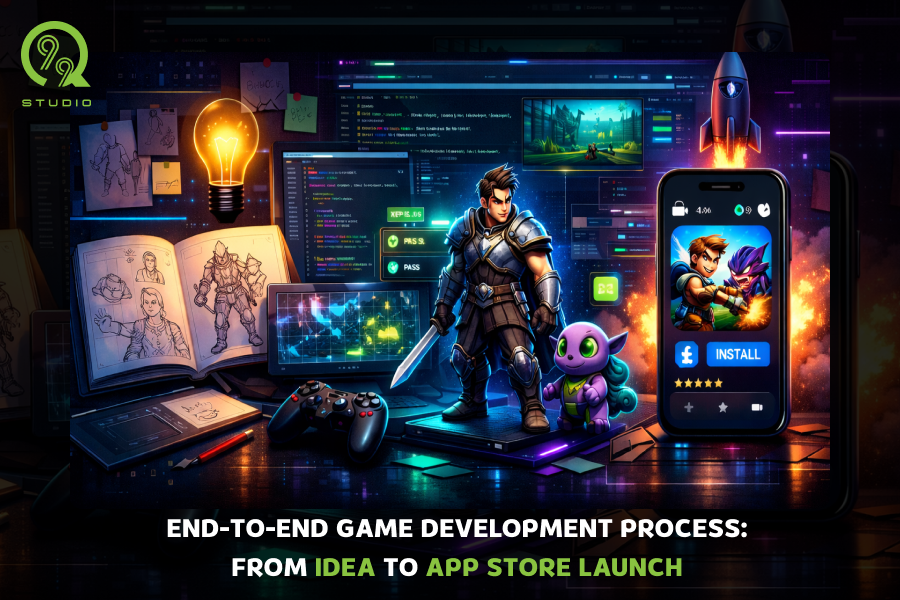
The App Store is a graveyard of great ideas. Every day, thousands of developers hit Publish, only to watch their games disappear into the digital abyss. Not because the idea was bad, but because the process was flawed.
In 2026, player expectations are ruthless. Attention spans are microscopic. A successful game isn’t just built on great code or beautiful art, it’s built on a disciplined, battle-tested development process. Winging it is no longer an option.
Whether you’re an indie developer working from a home office or a studio planning to hire a game developer for your next flagship title, this guide breaks down the complete mobile game development lifecycle from concept to long-term Live Ops success.
Phase 1: Pre-Production-The Strategic Blueprint
Before a single line of code is written, your job is to de-risk the idea. In a saturated 2026 market, your game must communicate its Unique Selling Point within the first three seconds of exposure.
Key pillars of pre-production:
- Concept Brief: Define your high-level concept and core gameplay loop. Why should players abandon the games they already love for yours?
- Market Analysis & Review Mining: Study top competitors and analyze their 1-star and 2-star reviews. Those complaints are unclaimed opportunities.
- Game Design Document: Your single source of truth. It outlines mechanics, progression, monetization, narrative, and crucially a Live Ops roadmap for the first six months after launch.
- Prototyping & Grey Boxing: Build early using simple shapes. If it’s not fun with cubes and spheres, visuals won’t save it. AI-assisted coding now helps teams iterate faster on controls and physics.
Phase 2: Production-Building the Machine
This is the longest and most resource-intensive phase of mobile game development. The goal is to produce a Vertical Slice a polished, playable segment that represents final quality.
Technical Foundations
Strong architecture matters. Whether you’re using Unity (C#) or Unreal (C++), scalable systems prevent performance bottlenecks later. While vibe coding is trendy, production stability still requires experienced engineers to avoid technical debt.
Asset Creation & AI Integration
Artists create characters, environments, and UI while audio teams craft immersive soundscapes. In 2026, AI-generated assets are commonly used for environmental variety trees, rocks, props freeing human artists to focus on hero assets like protagonists and bosses.
Level Design & Narrative Flow
Great games guide players without hand-holding. Level design balances pacing, difficulty, and storytelling. Adaptive Difficulty, powered by machine learning, subtly adjusts challenge based on player skill keeping users in the flow state longer.
Phase 3: Post-Production-The Polish & QA Gauntlet
A buggy game is a dead game. This phase turns a working build into a market-ready product.
- Alpha & Beta Testing: Alpha is feature-complete but rough. Beta focuses on balance and stability. Discord-based community betas now double as early marketing.
- Quality Assurance: QA tests edge cases network drops, interruptions, device fragmentation. It’s no longer just about bugs; it’s about how the game feels.
- Optimization: Players expect 60 FPS, minimal battery drain, and fast downloads. Tools like Android Vitals and Xcode Instruments help eliminate memory leaks and reduce install size.
Phase 4: Launch Preparation Mastering the Storefront
Launching a game is a marketing event, not a technical milestone. If you don’t have a plan 90 days before launch, you’re already late.
- App Store Optimization: Keyword research, compelling descriptions, and high-impact feature graphics drive organic installs.
- First-Time User Experience: Nearly 40% of users drop off within the first minute. Tutorials must be fast, rewarding, and visually engaging.
- Monetization Setup: The 2026 standard is Hybrid Monetization rewarded video ads paired with optional in-app purchases.
- Soft Launch: Release in a smaller market to validate retention and lifetime value before scaling globally.
Phase 5: Launch & Live Ops-The Service Era
The App Store launch is just the beginning. Modern mobile games are built as living services.
- Global Launch: Coordinate PR, influencers, and paid user acquisition. TikTok and YouTube Shorts Playables dominate install growth in 2026.
- Live Operations: Regular updates, seasons, and limited-time events keep players engaged. Top games ship new content every 2-4 weeks.
- Community Management: Actively responding to reviews and feedback builds trust and trust drives retention.
Beyond the Launch: Building a Lasting Hit
The difference between games that trend and those that vanish isn’t luck or budget it’s process. Teams that prototype with intent, polish relentlessly, and treat launch as the start of a service consistently outperform the rest.
The market is still hungry for something fresh. With the right roadmap, execution, and mindset, your game doesn’t have to join the graveyard.
Ready to Build Your Legacy?
Navigating modern game development alone is risky. If you’re looking to scale faster, reduce technical debt, or hire a game developer with real production experience, partnering with experts makes the difference.
Q99 Studio specializes in transforming ambitious ideas into high-performance mobile games. Whether you need dedicated developers or a full-service partner from pre-production to Live Ops we’re built to help your game succeed long after launch.




 B - 433-442, Money Plant High Street, Near Ganesh Glory, Jagatpur Road, S.G. Highway, Ahmedabad - 382470.
 11006 Kirker Ln, Richmond, TX 77407, USA